
Manufacturing Growth Meets Agentic Marketing with ForeFront
By Terry Luschen | Solutions Architect, ForeFront, an EPAM Company
Manufacturing organizations are under increasing pressure to deliver personalized experiences to distributors, channel partners, customers, and field service organizations while doing more with fewer resources. At the same time, most marketing teams want practical ways to adopt AI without disrupting the marketing programs that already drive their business.
Marketing Cloud Next offers a way to do both. It runs marketing natively on Salesforce, using the same Data 360 foundation, Flow automation, and security your sales and service teams already rely on. Your data barely has to move, every team works from one view of each customer and account, and built-in AI agents can take on work like answering onboarding replies.
For manufacturers still running Marketing Cloud Engagement or Account Engagement (formerly Pardot), the real question is how to get there without rebuilding everything at once. Our team combines deep manufacturing domain knowledge with hands-on Marketing Cloud Next and Data 360 expertise. We’re flexible, too – start with one high-value use case, like an AI agent that answers onboarding email replies using approved content, or migrate an entire email marketing program.
Either way, leveraging agentic marketing starts with one thing: Understanding how marketing connects to the entire customer lifecyle.
A Manufacturing Partner That Understands the Entire Customer Lifecycle
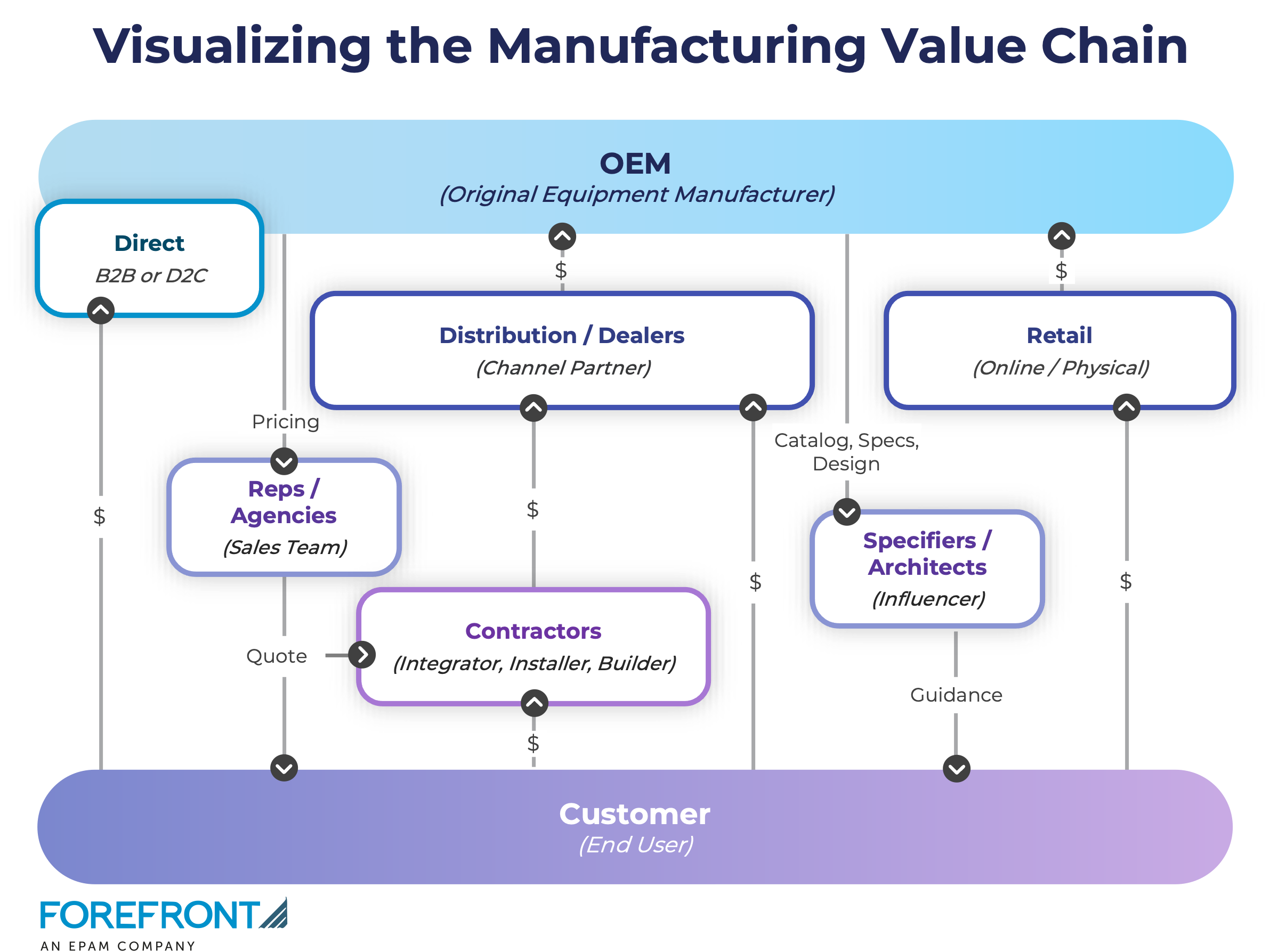
The manufacturing value chain is complex and includes direct, channel, and retail sales.
Manufacturing companies rarely operate with simple customer journeys. Interactions often span prospects, distributors, partners, service technicians, product support teams, and long-term customers. That’s why marketing can’t exist in isolation – it has to connect to the broader customer experience. ForeFront’s approach reflects this reality. We bring experience across the Salesforce ecosystem, including Data 360, Agentforce, Service Cloud, Commerce, Revenue Cloud, and Marketing solutions.
That lets us align your marketing activity with sales execution, customer service, field operations, and partner engagement, so every team works from the same view of the customer.
Rather than simply implementing technology, we focus on helping organizations rethink business processes, remove inefficiencies, and create scalable operating models that support future growth.
Cirrus Aircraft is a good example. We implemented Marketing Cloud journey mapping and distributed marketing alongside Automotive Cloud and Agentforce AI agents, so warranty-expiration notices and new-model announcements run on the same aircraft and ownership data the service team uses. On that same platform, AI case summaries save reps an estimated 15 to 20 minutes per case.
Why Clients Are Making the Move to Marketing Cloud Next
What Our Deep Marketing Cloud + AI Expertise Bring to Every Project
Our Marketing Cloud practice is built on real-world marketing platform experience.
Before leading recent Marketing Cloud initiatives, I served as a platform lead for both Data 360 and Marketing Cloud Next, helping to architect and lead numerous implementations. That background provides a practical understanding of what it takes to build successful marketing ecosystems that are scalable, governable, and capable of delivering measurable business outcomes. I also served on the Salesforce Marketing Cloud Partner Advisory Board (PAB) for 2026, giving direct feedback to the Marketing Cloud product team during a period of heavy migration to Data 360 and Marketing Cloud.
That experience shapes the key considerations we work through before a project starts:
- How do my forms, and the data collected from them, fit into my early-funnel marketing strategy?
- How do I collect and manage the consent and preferences of my customers?
- Which parts of my marketing automation programs will take more effort to architect so they scale?
- How do we organize segments and exclusion criteria to make life as easy as possible for our front-line marketers?
Many organizations are excited about AI but struggle with where to begin. Others have mature marketing automation programs and want to understand how Marketing Cloud Next fits into their future-state architecture.
We help clients in both situations.
Because we understand the underlying data foundation, customer segmentation strategies, campaign execution models, and marketing operations processes, we can guide customers through the entire journey. Whether the objective is better personalization, higher operational efficiency, improved customer engagement, or AI-powered automation, our team will align product capabilities with tangible business goals.
Start Small or Transform Everything All at Once, We’re Flexible
One of the strengths of our delivery model is flexibility.
Some customers want to begin with a focused, high-value use case that demonstrates business value quickly. Others are ready to migrate an entire email marketing ecosystem onto Marketing Cloud Next.
We support both approaches.
A good example of a targeted AI use case is automated onboarding communications. Imagine a new customer or partner replies to an onboarding email. Instead of requiring a marketing or customer success representative to review and respond manually, Agentforce agents can act immediately.
Marketing Cloud’s AI-powered capabilities can analyze and interpret the incoming email, then use Prompt Templates and business rules to generate a personalized response based on approved company content, onboarding procedures, and customer-specific context. That response can then be returned to the sender automatically, which reduces response times without pulling a person into the loop.
This type of implementation delivers value quickly, carries limited risk, and produces measurable efficiency gains. It also serves as a practical introduction to agentic AI without requiring a large-scale transformation effort.
We took this approach with Kawasaki Engines, piloting a focused agent that answers dealer questions like “Which spark plug fits this engine?” inside a B2B Commerce storefront that generated $6.5M+ in its first 90 days.
For organizations with broader ambitions, ForeFront can help migrate and modernize entire email marketing programs. We assist with data strategy, segmentation, content migration, automation redesign, campaign orchestration, governance, training, and operational readiness. Our goal is to create a foundation that supports both current initiatives and future AI-driven innovation.
Every Marketing Cloud Next project starts by setting up Data 360 properly. We minimize duplicates, create unified Individuals, and lay out record attributes in a well-organized data model so the Segmentation screen within Data 360 is easy to use. Getting the data right makes downstream processes such as segmentation for marketing much easier. It’s the first of the three pillars that make AI actually work for manufacturers.
We’ve seen what that foundation unlocks. For a global lime producer, we started with architecture before configuration, connecting IFS ERP to Salesforce through MuleSoft to build a unified Account 360 view. That foundation is what makes their next phases possible.
Accelerate Success with Our Marketing Automation to Marketing Cloud Next QuickStart
Many clients are eager to begin but need a structured path to adoption. That’s why we offer a Marketing Automation to Marketing Cloud Next QuickStart designed to accelerate implementation while minimizing complexity.
The QuickStart package focuses on establishing a production-ready foundation and delivering business value quickly. Typical activities include:
- Kickoff, discovery alignment, and project coordination
- Basic Data 360 configuration and foundational data model setup using standard bundles
- Domain warming on a shared or dedicated IP address
- CMS Workspace setup and creation of initial email templates
- Subscriber preference center and unsubscribe management configuration
- Migration of a couple of Account Engagement (formerly Pardot) Engagement Programs or Marketing Cloud Engagement (MCE) Journeys into Salesforce Flow
- Rebuild of one to two Account Engagement forms or MCE CloudPages as Marketing Cloud Next forms
The result is a guided implementation that provides immediate capabilities while establishing best practices for future growth.
The ForeFront Difference
Technology alone doesn’t create transformation. Success comes from combining business understanding, industry expertise, platform knowledge, and a practical implementation strategy.
ForeFront’s strength in manufacturing, combined with our deep Marketing Cloud and agentic marketing experience, allows us to guide clients wherever they are in their journey. Whether you need a focused AI-powered use case, a modernized email marketing platform, or a comprehensive Marketing Cloud strategy, we can help you move forward with confidence.
The organizations that gain the greatest value from AI aren’t necessarily the ones that start biggest. They’re the ones that start intelligently, build on a solid foundation, and partner with experts who understand both the technology and the business outcomes they’re trying to achieve.
If you’re ready to get started and want to determine where Marketing Cloud Next fits into your roadmap, contact ForeFront today or reach out to me on LinkedIn.
Want to know more?
For information on how AI is changing the way we deliver Salesforce projects for manufacturing, contact ForeFront at marketing@forefrontcorp.com.
About the Authors
Terry Luschen is a Solutions Architect at ForeFront, an EPAM company, where he leads Marketing Cloud Next and Data 360 initiatives. He has spent years as a technical architect and delivery leader in the Salesforce ecosystem, including serving as platform lead for Marketing Cloud and Data 360 and architecting numerous implementations. Terry currently holds 22 Salesforce certifications and served on the Salesforce Marketing Cloud Partner Advisory Board.