
How Manufacturing Cloud Solves the 6 Biggest Gaps in Sales Cloud
By Chris Cook, VP Global Sales & Manufacturing Practice
When I first implemented Salesforce at a manufacturing company years ago, before Manufacturing Cloud even existed, we had to build everything custom. Forecasting. Pricing. Channel visibility. All of it.
Luckily, these days Salesforce has a product that’s purpose-built for the industry: Manufacturing Cloud.
Don’t be confused by the name, Manufacturing Cloud is not an MRP (Manufacturing Resource Planning) tool. Instead, it’s built to handle the layered complexity of manufacturing account relationships, pricing models and variability, disconnected selling channels, and run-rate business.
If you’re trying to manage all that in Sales Cloud alone, I’m sure you’ve heard some of these common gripes from the users…
- Salesforce doesn’t match how we run our business.
- How am I supposed to track run-rate business when I don’t even quote it?
- How do I know if my distributors are performing to plan?
- Creating an opportunity for every project/order takes way too long.
- The forecast/pipeline isn’t accurate, it doesn’t include everything.
- Salesforce is nothing more than a glorified Rolodex.
I heard all of this (and more) time and time again. The problem is manufacturers are trying to shove a square peg in a round hole with Sales Cloud, but unlocking real value from Salesforce means rethinking how you use the platform to manage revenue, programs, and performance (not just track deals).
Here are six ways Sales Cloud falls short, and how Manufacturing Cloud closes the gap.
6 Reasons Sales Cloud Isn’t Enough for Manufacturers
- 1It Doesn’t Reflect How Manufacturers Make Money
- 2Recurring Revenue is Invisible
- 3Channel Complexity Breaks the Data Model
- 4Sales Reps Don’t Trust the System
- 5Sales Agreements Live in PDFs and Are Enforced with a Handshake
- 6Forecasting is Fragmented or Fictional
1. It Doesn’t Reflect How Manufacturers Make Money
Manufacturers don’t rely on a traditional win/loss opportunity → quote → fulfillment cycle. They sell through long-term, high-volume relationships, with recurring volume orders and custom pricing agreements across multiple channels. Sales Cloud isn’t designed to track these patterns, which leaves the CRM disconnected from business reality.
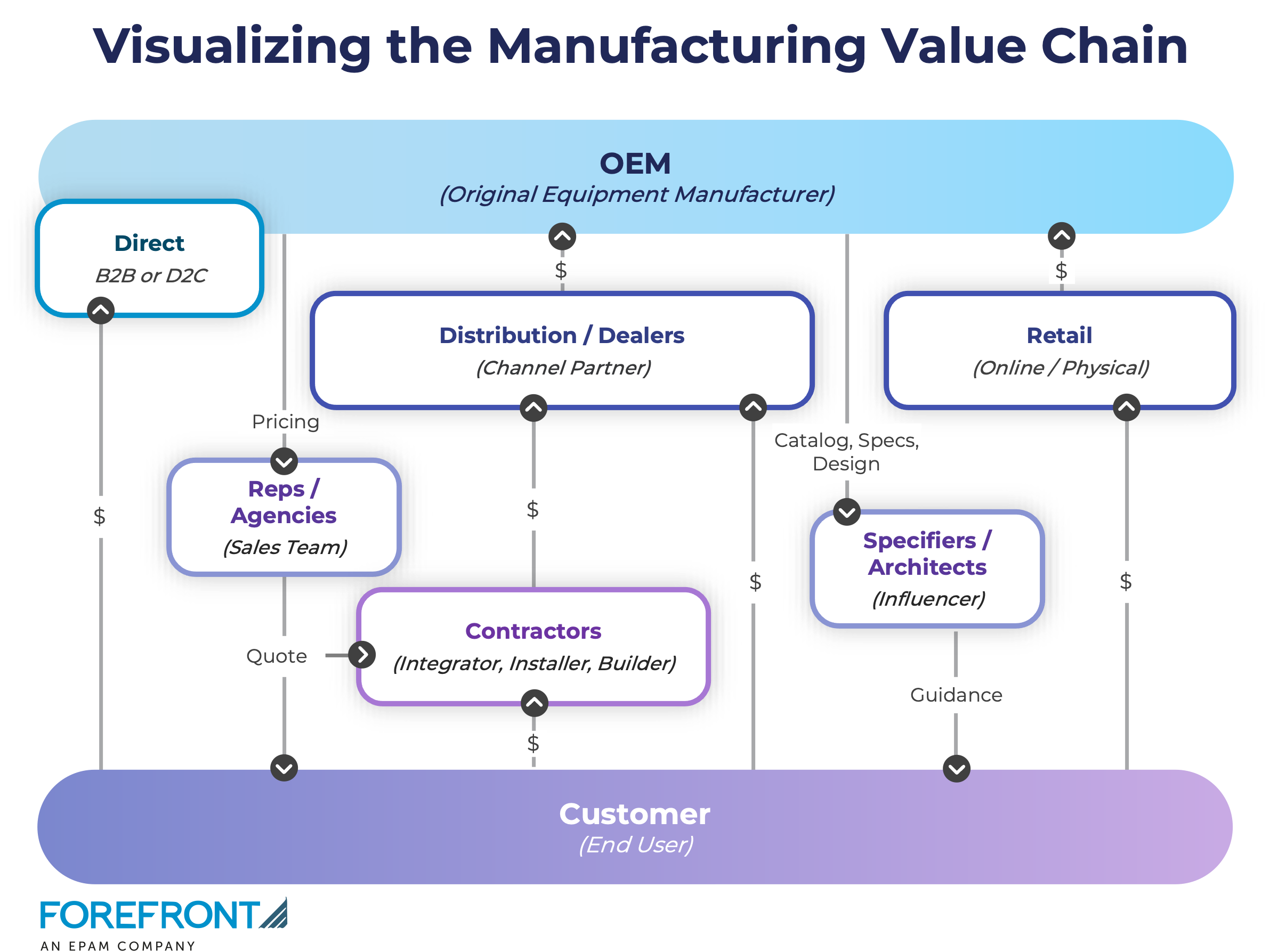
The manufacturing value chain is complex and includes direct, channel, and retail sales.
One of ForeFront’s clients, a global leader in the design and manufacture of color concentrates and functional additives, has a diverse customer base that includes companies in transportation, infrastructure, building and construction, consumer packaging, and consumer and industrial durable goods.
Let’s say a loyal OEM (Original Equipment Manufacturer) customer places an order. There’s no opportunity record. No quote. Just recurring volume that has to be forecasted, tracked, and analyzed so that they can properly demand plan, optimize inventory levels, and enhance profitability.
Sales Cloud doesn’t have a built-in way to handle that.
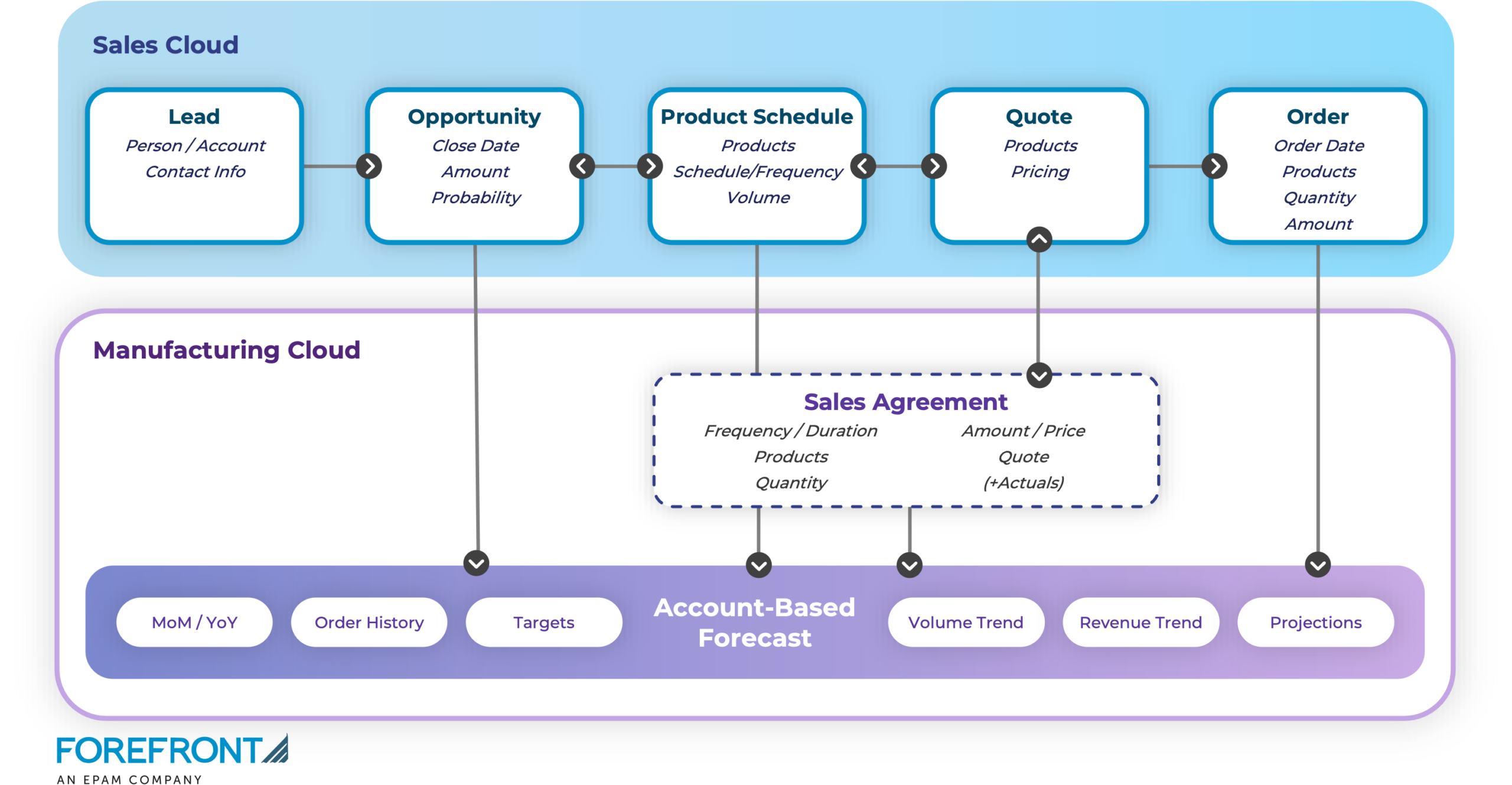
This diagram shows how Manufacturing Cloud builds on Sales Cloud by adding sales agreements and account-based forecasting to enable visibility into recurring revenue, volume trends, and actual order performance.
2. Recurring Revenue Is Invisible
Run-rate business is the lifeblood of many manufacturers, but Sales Cloud can’t forecast it because it lives outside of the standard opportunity object model. If revenue comes in through recurring EDI (Electronic Data Interchange) orders, portals, or direct purchase flows, reps are operating blind… and so is the executive team.
That same coatings client I mentioned earlier used to rely entirely on spreadsheets to understand their largest accounts. We helped them turn that into structured, real-time visibility through Manufacturing Cloud’s Account-based forecasting.
3. Channel Complexity Breaks the Data Model
Because sales go through dealers, contractors, reps, retailers, and aggregators, many manufacturers have no clue who their end customers are. One of my old clients sold electrical and lighting control equipment through all three major channels: direct, distribution, and retail. That’s chaos without the right data structure.
Sales Cloud’s standard account-contact model can’t handle that level of complexity, but Manufacturing Cloud provides a way to visualize and influence the full value chain. As a result, leaders are equipped to make smarter decisions about where to focus marketing and business development budgets.
4. Sales Reps Don’t Trust the System
I hear it all the time: “Our reps don’t use Salesforce.” It’s not a training issue, either. It’s a trust issue. If Salesforce doesn’t reflect the real-world pricing, quoting, and performance data that reps need, they’re going to live in email inboxes and spreadsheets instead.
We worked with a manufacturer and distributor of commercial concrete construction accessories and chemicals to design a Salesforce solution aimed at eliminating spreadsheet chaos and improving forecast accuracy.
The implementation leveraged Manufacturing Cloud, CPQ, and real-time ERP integrations to give sales teams a single source of truth for account activity, inventory availability, margin visibility, and quoting performance, all with the goal of rebuilding confidence in the system and driving long-term adoption.
5. Sales Agreements Live in PDFs and Are Enforced with a Handshake
Oftentimes, in manufacturing are managed offline, sometimes in a contract, often in someone’s inbox. But if you’re not tracking actual volume against committed targets, you’re losing money.
When Penn Color, a global manufacturer of color concentrates and pigment dispersions, first came to ForeFront this was one of the challenges they were hoping to solve with Salesforce. They needed a better way to manage sales across multiple regions and channels but had no structured way to track performance against pricing commitments.
Manufacturing Cloud hadn’t been released yet, so ForeFront built a run-rate forecasting and quoting model within Sales Cloud that includes product-level pricing, margin visibility, and ERP integration. The result was a scalable framework to enforce sales agreements, improve forecasting accuracy, and align sales teams around shared targets.
Volume commitments and pricing agreements are critical to profitability for many manufacturers, but in Sales Cloud, they’re rarely enforced. Manufacturers end up fulfilling orders without confirming whether the agreed-upon volume thresholds are being met. That opens the door to pricing inconsistencies, margin leakage, and missed renegotiation triggers. Manufacturing Cloud provides a structured way to bring pricing agreements into Salesforce (and tie them to real-time order data) so sales teams can see what was promised, what’s been delivered, and what needs to change.
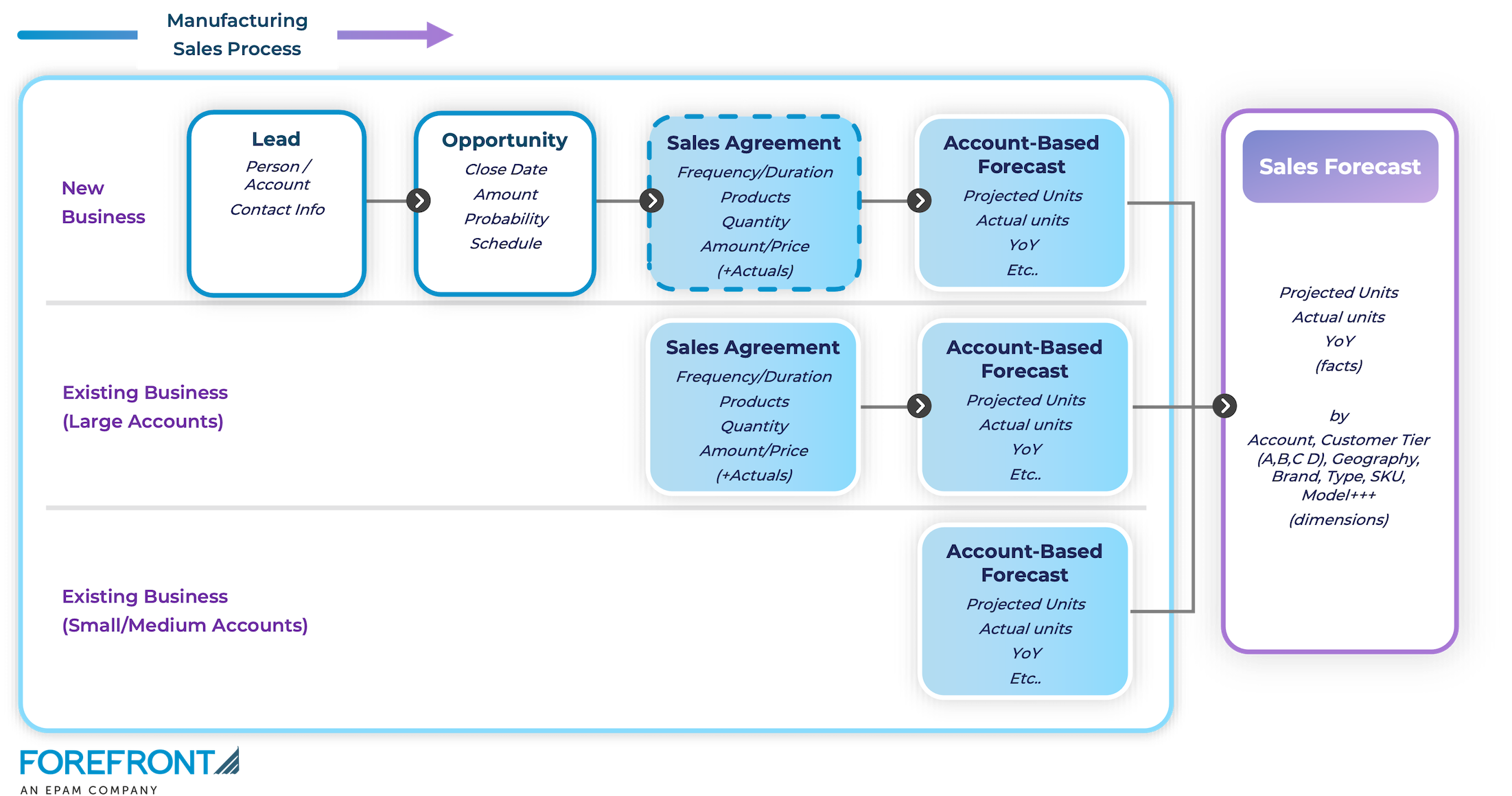
This diagram shows how sales agreements feed account-based forecasts across new and existing business to create a unified, data-driven sales forecast based on actuals, volume, and key account dimensions.
For manufacturers managing high volumes, complex pricing tiers, or rebate structures, Revenue Cloud Advanced (RCA) can even be layered in to automate enforcement logic, streamline approvals, and ensure agreement terms are applied consistently.
6. Forecasting is Fragmented or Fictional
Bid-inflated pipelines. Duplicate quotes. Disconnected ERP systems. It’s no wonder forecasting in manufacturing often feels like guesswork.
One ForeFront customer had a 30-year-old Excel pricing model. That meant pricing and forecasting were error-prone and reactive. We built them a custom CPQ engine integrated with SAP and Salesforce. Now they know their margins in real time, pricing aligns with contracts, and their forecasts are grounded in actual order data.
How Manufacturing Cloud Fills the Gaps Left by Sales Cloud
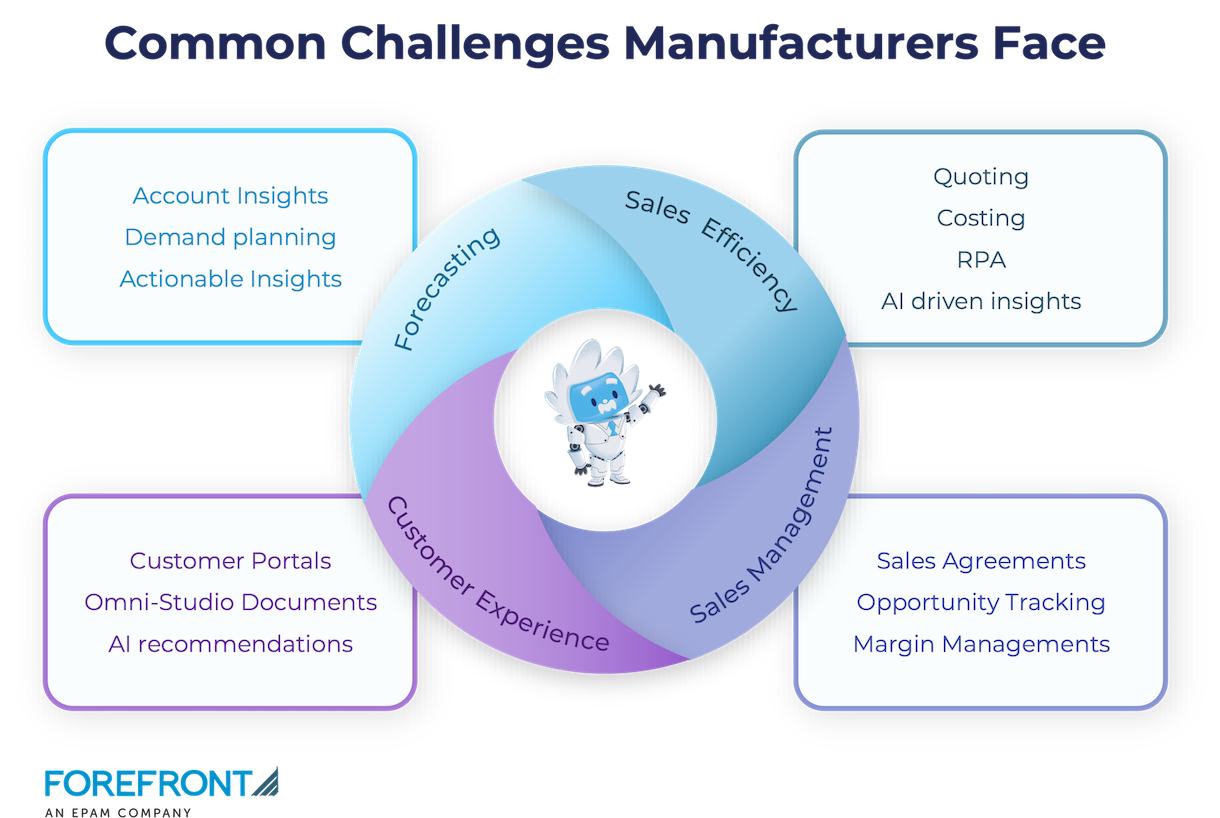
Manufacturers commonly struggle with forecasting, sales efficiency, sales management, and delivering exceptional customer experiences.
Salesforce designed Manufacturing Cloud to address the exact gaps Sales Cloud leaves behind, especially in organizations where revenue doesn’t follow a clean opportunity path. Instead of trying to shoe-horn run-rate business into standard Sales Cloud functionality, Manufacturing Cloud introduces features that better align with how manufacturers actually sell and operate.
These key capabilities are game changers for manufacturers looking for a solution that aligns with the way business works:
1. Account-Based Forecasting
Traditional forecasting tools rely on pipeline volume and probability, which doesn’t help when the biggest accounts aren’t tied to open opportunities. Account-based forecasting lets manufacturers model expected revenue at the account and product family level, based on actual order history and rep input. It ties past performance to forward-looking targets, giving leadership a real view of an account’s health and growth potential.
Frankly, any manufacturer that sells through a channel or has recurring business should be taking advantage of this feature. It’s shocking how many Manufacturing Cloud customers don’t have it turned on.
We’re currently implementing this for a plastics manufacturer that needed more accurate forecasting to align production with demand for their highly customized products. The solution includes syncing multi-tier, volume-based quotes between Salesforce and Oracle EBS, and tying sales forecasts to a demand-planning engine to trigger timely buys of materials. Account-based forecasting will give them the visibility they need to forecast sales and plan manufacturing operations with confidence.
2. Sales Agreements That Actually Work
Most manufacturers don’t track whether a customer is buying what they promised to buy. They just hope they are. Manufacturing Cloud provides a structured way to track volume commitments, pricing thresholds, and performance against contractual agreements.
Instead of buried PDFs or one-time quotes, reps can monitor whether accounts are meeting their agreed-upon purchase volumes. If they aren’t, it’s easy to adjust incentives and pricing. No more margin slippage due to underperformance.
3. Integrated Product Catalogs and Customer-Specific Pricing
Sales teams need answers in the moment… not after three calls to pricing or ops. Manufacturing Cloud includes enterprise product catalog management, so reps can access accurate SKUs, specs, inventory, and customer-specific pricing during visits. This reduces friction in quoting, speeds up order creation, and builds trust with buyers.
At another ForeFront customer, Lamons Manufacturing, had a legacy quoting process built around tribal knowledge and disconnected systems, which made pricing accuracy a constant challenge. Their team handled thousands of made-to-order requests annually, many of which included minor variations that still required custom quoting.
By combining Manufacturing Cloud with CPQ and B2B Commerce, they built a consistent, repeatable way to configure products, manage pricing logic, and support scalable reordering — all while maintaining visibility into the underlying run-rate business. The result was a faster, more accurate quoting process and a significantly better customer experience.
4. Easy-to-Understand Value Chain with the Actionable Relationship Center
Many manufacturers have no idea where their products ultimately end up, especially when selling through layers of dealers, contractors, and influencers. Just look at the Manufacturing Value Chain again and you’ll see why this is the case.
Manufacturing Cloud and the Actionable Relationship Center help visualize these relationships so teams can track influence, identify demand drivers, and make better go-to-market decisions.
Manufacturing Cloud helps connect these dots through tools like the Actionable Relationship Center (ARC), which shows you who’s influencing demand, where product is going, and how to act on it. This gives sales and marketing teams a clearer picture of who’s driving demand and how to influence it.
An Important Caveat with Manufacturing Cloud: ERP Integration is Non-Negotiable
Let me be blunt: Manufacturing Cloud is only as good as the data behind it. Without ERP (Enterprise Resource Planning) integration, you’re flying blind.
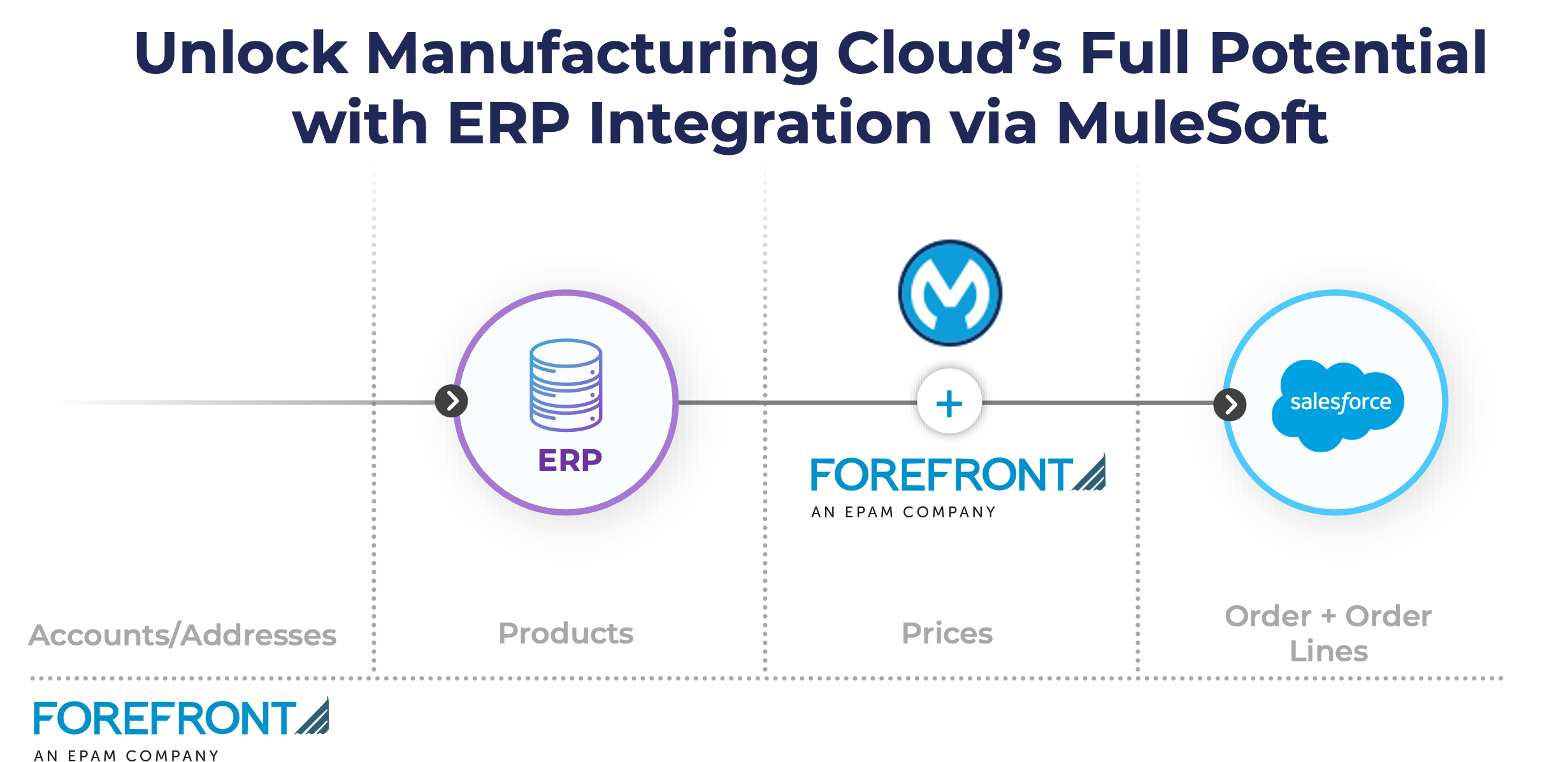
This diagram shows how ForeFront uses MuleSoft to connect ERP systems to Salesforce — bringing in critical data like accounts, products, pricing, and orders.
Order data is what connects the dots between volume commitments, pricing agreements, and actual revenue performance. If you can’t bring in real-time (or near real-time) order history, forecasts won’t reflect reality, sales agreements won’t be enforced, and reps won’t trust what they see in Salesforce.
This isn’t about plugging in a data stream and calling it done. ERP systems like SAP, Oracle, Infor, and Epicor all have different data structures, and many manufacturers use multiple platforms or heavily customized systems. The goal isn’t just to sync data, it’s to align CRM functionality with how the business actually operates across pricing, revenue recognition, and fulfillment.
Of course, just buying Manufacturing Cloud isn’t enough either. I’ve seen plenty of manufacturers invest in the product and then barely turn on the features that actually move the needle, like account-based forecasting or sales agreements. Sometimes it’s a configuration issue, sometimes it’s internal adoption, but either way, it results in wasted license spend and missed value.
Building a Foundation for AI-Ready Manufacturing
There’s another big benefit to proper ERP integration: Once you have a foundation of clean data, ERP alignment, and properly configured features, capabilities like Einstein reporting and AI start to add value. Manufacturing leaders are increasingly asking about AI-readiness, but most systems aren’t there yet. With the right groundwork, though, Einstein can help surface sales trends, highlight risk in key accounts, and support smarter, more proactive forecasting.
Don’t Just Track Deals, Track the Entire Business
Manufacturing Cloud is more than another product SKU in the Salesforce ecosystem. It delivers an operational shift that aligns with how manufacturing businesses make money:
- Through channels
- Through agreements
- Through ongoing customer demand
When properly implemented, it drives adoption, improves forecasting accuracy, and makes it possible to serve every channel with confidence. Manufacturing Cloud customers get accurate forecasts, better rep adoption, and insight into performance at every level of the value chain, from program-based incentives to run-rate product volume.
And if you’re already using Sales Cloud, upgrading to Manufacturing Cloud doesn’t mean starting over. It means building on what you have and transforming Salesforce from a passive reporting system into an active driver of revenue visibility, performance, and growth.
About the Authors
Chris Cook is VP of ForeFront’s Global Sales & Manufacturing Practice. With nearly two decades of experience in the manufacturing space, including eight years leading Salesforce initiatives at a global manufacturer, Chris brings a hands-on understanding of the challenges manufacturers face and the systems that solve them. Want to learn more about how ForeFront helps manufacturers modernize forecasting, quoting, and sales operations with Salesforce Manufacturing Cloud? Explore our solutions here.