

How Voice-Activated AI Transforms Field Service Operations
By James Goodman, Salesforce Practice Director at ForeFront
Manufacturers are under constant pressure to deliver faster service, reduce downtime, and improve the customer experience without adding headcount. For organizations with field service teams, voice-enabled AI is one practical way to achieve those gains. It removes friction from daily field workflows, strengthens data quality, and gives leadership clearer visibility across the business. Because it works hands-free, voice AI perfectly fits the reality of how technicians operate in the field.
Field service teams face tough, hands-on work. They’re often out in extreme conditions, dealing with complex equipment, and racing to fix problems before they cause costly downtime. On top of that, many technicians are expected to use digital tools that were originally built for office workers… not for people wearing gloves, climbing ladders, or working on remote sites. It’s no surprise that notes often get delayed, steps get skipped, and data quality suffers.
Contrast that with voice-enabled AI, powered by Agentforce, where technicians can use voice prompts to accomplish everything they need to do in Salesforce. Voice AI turns mobile devices into hands-free copilots that give techs real-time access to the information, guidance, and data they need, all without touching a screen. This makes their jobs simpler, faster, and safer, and also drives measurable gains in the metrics that matter most to manufacturing leadership.
In this article, I’ll explore the top reasons voice-enabled AI capabilities can be transformative for field service teams, real-world use cases that showcase high-value examples of how manufacturers can put voice AI to work today, and best practices techs (and the people training them) need to keep in mind when using voice tools in the field.
Why Voice-Enabled AI is a Game-Changer for Field Service
Field work is physical and fast-moving. When technicians can remove friction from time-consuming and manual daily workflows, the efficiency gains and time savings compound quickly. It’s an outcome we’ve seen time and time again at ForeFront.
One of our customers, an oilfield services provider, saw firsthand how removing friction in manual workflows can generate significant time savings. In this engagement, ForeFront built custom Salesforce Field Service (SFS) components to support critical field service workflows. With SFS, technicians and other Salesforce users can quickly create quotes, generate work orders, and more, for an estimated 40% time savings.
This project occurred pre-Agentforce, but it’s a great example of how we leverage innovative technology to configure intuitive tools that deliver measurable efficiency gains. We can carry those same principles into the next frontier of field service innovation by using Agentforce and voice AI to give technicians hands-free access to the tools they need on the job. With that in mind, here are the top reasons voice-powered AI is worth considering for manufacturers with field teams.
1. Field Work Is Hands-On
Touchscreens were never designed for job sites. Most techs are wearing gloves, carrying tools, or working in conditions where tapping on a screen isn’t practical. They’re on ladders, inside equipment enclosures, or in busy industrial environments. Even with rugged devices, usability drops fast.
We’ve seen how small actions like checking inventory, scanning a manual, or updating a work order can take longer than they should, or get skipped entirely. Voice eliminates those moments. When a tech can ask for asset history or dictate a note without stopping the task, they stay focused on the work that matters.
2. Talking Is Faster Than Typing
Most people can speak a lot faster than they can type. With voice input, techs can move through their workflows without digging through menus or tapping through screens. They can check part availability, update case status, or log completion notes in seconds. That improvement compounds across every service call and leads to faster response times and more productive teams.
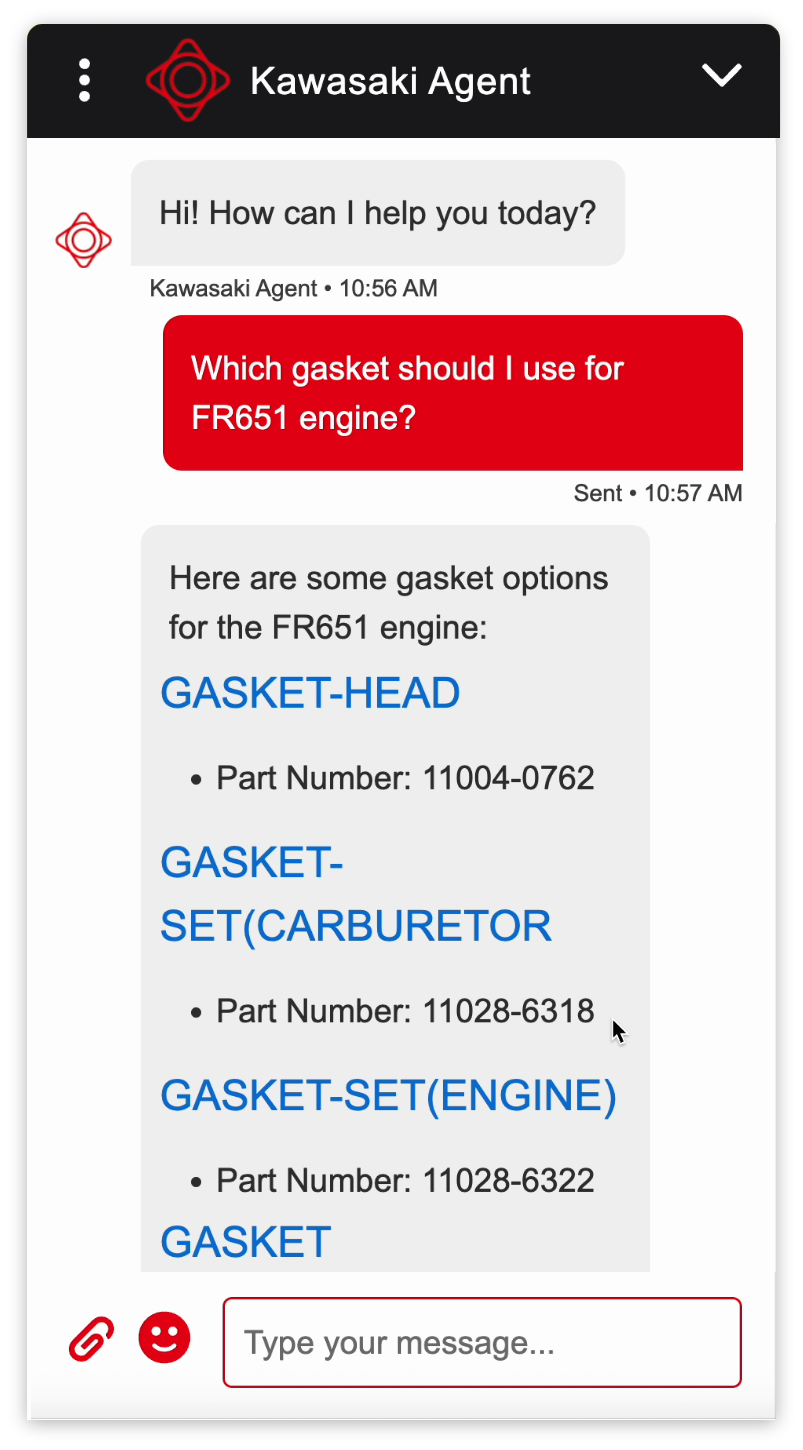
We saw the impact of these compounding time savings when working with Kawasaki Engines. ForeFront helped modernize their B2B commerce storefront and created a faster and more intuitive way for thousands of U.S. dealers to access parts and service information. An Agentforce-powered Service Agent on the storefront allows dealers to type natural language queries like “Which gasket should I use for an FR651 engine?” and instantly receive an answer, complete with inventory data and an option to add the part to their cart. Voice-enabled workflows build on the same principle: make it faster and easier for users to get the information they need without slowing down their work.
3. Better Notes = Better Data
Good data is the backbone of effective service operations. But it’s hard to record details when you’re holding tools or working in rough conditions. Voice prompts make it easier. Techs can describe what they did, what they observed, and what needs to happen next, right in the moment. Cleaner notes support downstream work, improve compliance records, and give service leaders clearer visibility.
Richer notes also feed Agentforce. With better data, the system can recommend upsells, replacement parts, and next-step services tailored to each situation. At ForeFront, we take this a step further by configuring Agentforce to transform a variety of unstructured inputs, including dictated notes, text –based updates, email threads, PDF snippets, and more, into structured fields that support reporting, forecasting, and analytics. This turns the messy reality of field work into clean, usable data leadership can act on.
This is the same approach we used with Cirrus Aircraft. Their teams needed clearer asset histories and more reliable service records across complex equipment. ForeFront designed an Agentforce-powered solution that automatically summarizes aircraft asset histories, aggregates data across cases, and pulls unstructured email content into the case record. What used to require manual review now happens in seconds, saving an estimated 15-20 minutes per case lookup.
4. Consistency Across Teams & Languages
In multilingual or distributed workforces, voice-to-text reduces errors caused by spelling differences or inconsistent terminology. The result is cleaner data in Salesforce, clearer visibility for service managers, and a more accurate picture of what’s happening in the field.
5. Improved Customer Satisfaction
Voice AI helps deliver a smoother, more reliable service experience for customers.
Faster updates mean fewer delays, and better notes lead to clearer communication and fewer return visits. Techs can resolve issues quickly because they have the right information at the right moment, and they can easily access it without getting pulled away from the task at hand.
All of this adds up to shorter downtimes, more predictable appointments, and a higher level of trust between manufacturers and the customers who rely on their equipment.
Field-Tested Use Cases for Voice-Enabled AI
Here are some concrete examples of the most valuable applications we’re seeing for voice-activated AI in field service operations for manufacturers and other industrial, consumer, and energy organizations.
1. Real-Time Case Status Checks
A technician asks, “What’s the status of case 8372 for line three?” Agentforce returns the current stage, the assigned rep, and the last update without requiring a single tap.
2. Parts Lookup in the Field
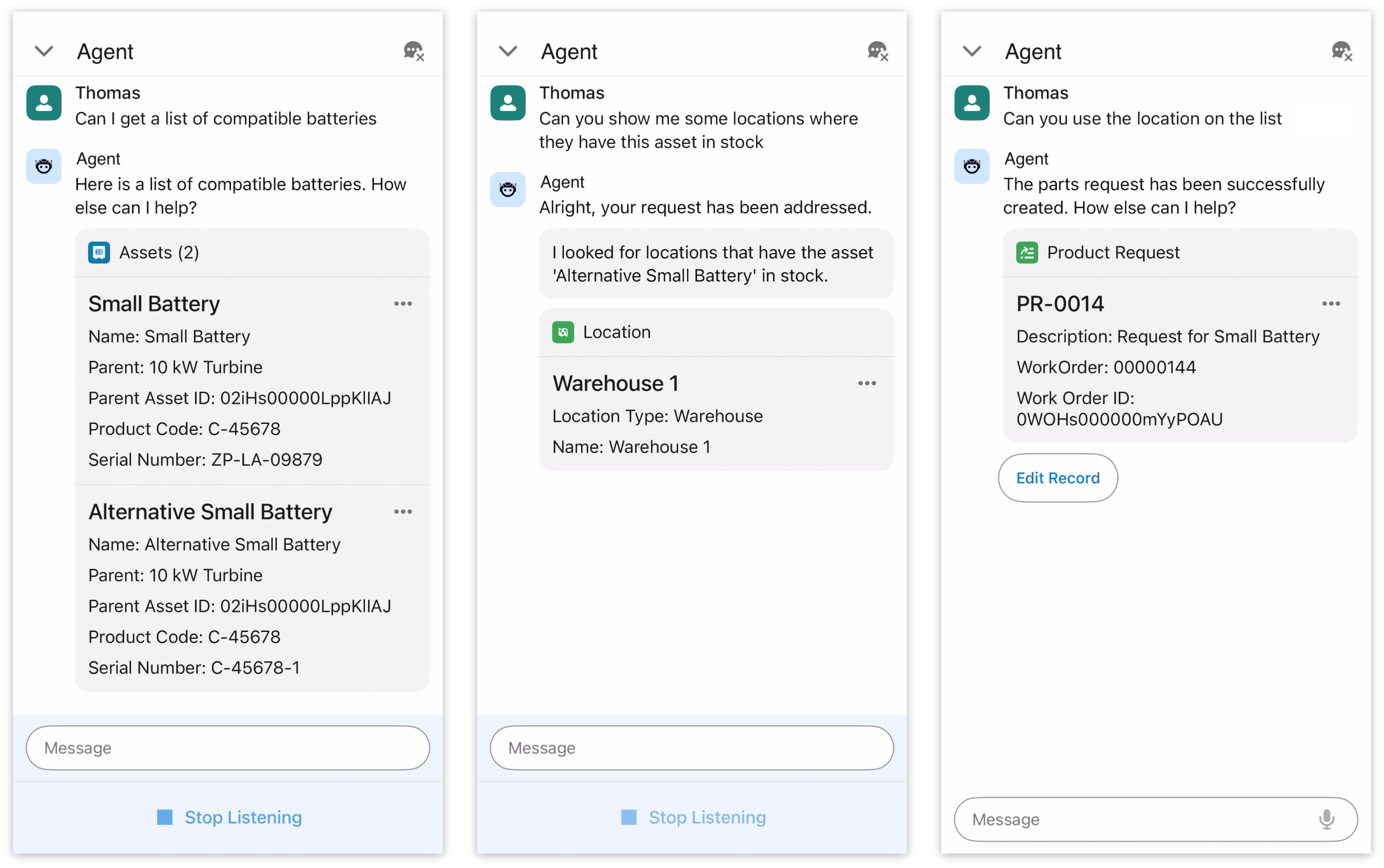
During a turbine inspection, the tech asks, “Can I get a list of compatible batteries?” Agentforce queries the ERP via MuleSoft and responds with availability and warehouse location.
3. Troubleshooting on the Fly
When diagnosing a pressure valve, the tech says, “What’s the install torque for GX-60?” Agentforce searches uploaded PDF manuals in Data Cloud, extracts the correct value, and cites the source.
4. Logging Work Without Typing
After completing a repair, the tech says, “Finished replacing the drive assembly on Model Y. Test passed.” Agentforce transcribes the note into the Service Appointment record and updates the Work Order status.
5. Safety or Compliance Reporting
If an incident occurs, the tech can say, “Log a safety issue at loading dock two, minor chemical spill.” Agentforce creates a new safety case, attaches it to the site record, and notifies the safety manager automatically.
Each of these examples eliminates manual input, improves data accuracy, and ensures work gets documented even under field constraints.
Best Practices for Using Voice-Enabled AI Tools in the Field
Voice AI works best when it’s clear, consistent, and secure. Here are some guidelines that you can share with field teams to ensure they have the knowledge and training needed to use these new tools effectively.
- Keep Voice Prompts Simple: Encourage and provide example of clear and consistent phrasing. For example, “Check status of case 2345” is easier for AI to process than “Where are we at with that case I opened last week?”
- Provide Context: Voice commands work best when they include specific context such as the asset ID, part number, or case reference. Sharing this information in the voice prompt helps the agent locate the correct data without the need for additional clarification.
- Plan for Errors and Misinterpretations: Even with good setup, AI will occasionally misinterpret commands. Build fallback prompts like “Did you mean the compressor fault or the pump assembly?” into your system and give the user an easy way to confirm or retry.
- Prioritize Security and Governance: Voice data can include sensitive or regulated information. Confirm all voice-to-text services comply with your organization’s privacy standards before deploying these capabilities.
When implemented well, these best practices make voice input as dependable as any other system interaction, with the added benefit of being far more natural for field users.
Why Manufacturers Should Care About Voice AI
Voice-enabled AI boosts technician productivity, strengthens data quality, and reduces the operational friction that slows service teams down. Manufacturers get faster service cycles, cleaner records, and better visibility across their installed base. Technicians get safer, more intuitive tools that match the realities of their work.
As margins tighten and customer expectations rise, these gains make a difference. Manufacturers that adopt voice-first workflows now will see quick improvements in efficiency and accuracy, and they’ll be better prepared for the next evolution in field service.
About the Authors
James Goodman is a Salesforce Practice Director at ForeFront, where he helps manufacturers strengthen field operations with practical, outcome-driven technology solutions. With more than a decade of experience leading transformation initiatives, his work spans strategic road mapping, change leadership, and delivering Salesforce solutions that make frontline teams faster and more effective.